Neverskilling
What happens to medical learners in a world where AI is doing their work?

Conversations about how AI will change skill acquisition in medicine tend to split into two stories:
(1) AI as something that helps clinicians do more = UPSKILLING
(2) AI as something that gradually erodes their skills = DESKILLING
There is a third possibility.
A world where learners grow up with AI present from the start, so some tasks are almost always handled by the system. Not losing a skill you once had. Never building certain cognitive, technical or perceptual abilities, because AI was always doing a task.
That is neverskilling.
In an era where learners are entering into medical training having only been exposed to AI, this certainly will happen.
The interesting question is which skills we are comfortable offloading, which ones we want to protect, and what new abilities learners should develop when AI is part of routine practice.
Defining neverskilling
It is useful to distinguish three related ideas.
Upskilling: AI tools extend human capability. For example, rapid documentary synthesis on patient histories reduces time on lower value work and lets clinicians focus on reasoning and communication.
Deskilling: skills that were once present degrade because a support system is used repeatedly. Classic examples include remembering phone numbers when they are all in your phone; navigation skills after GPS adoption; or even simple mental arithmetic after calculators.
Neverskilling: learners never acquire the underlying skill in the first place, because AI is consistently present whenever that task appears. I would use as a parallel example - grade school students may never learn how to write in cursive, partially because of the speed and ease word processing
(The joke of doctors not being able to write legibly will disappear - students never write prescriptions anymore because EMRs are doing it!)
In neverskilling, the learner is not disengaged. They may be working hard in a high volume environment. The difference is that key parts of perception, pattern recognition, or structuring are already performed by the system before the learner has a chance to experience and practice them.
The educational question is not whether neverskilling will occur. In some areas it almost certainly will, because it is inefficient to insist on manual performance when a safe, regulated, automated solution exists. Rather, the question is how to decide which skills we are willing to let go, which must be maintained at a baseline level for safety, and what new meta skills around AI oversight and use should be added.
Abdulnour and colleagues define this cogently in their article from the summer in NEJM - the figure of which is below:
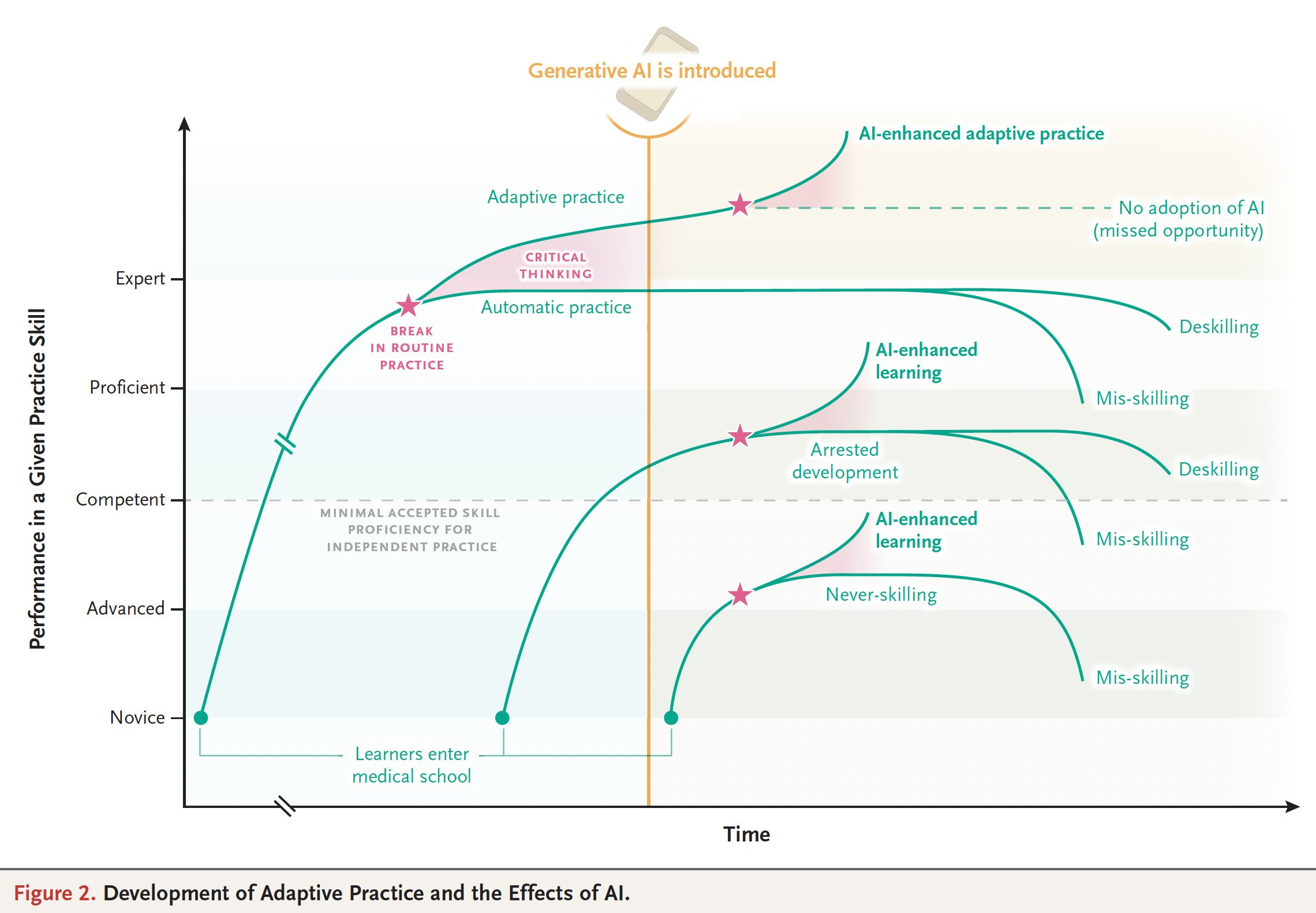
(from Abdulnour RE, Gin B, Boscardin CK. Educational Strategies for Clinical Supervision of Artificial Intelligence Use. N Engl J Med. 2025 Aug 21;393(8):786-797. doi: 10.1056/NEJMra2503232. PMID: 40834302.)
Assume AI is a partner in reasoning that can reduce cognitive load, structure information, and generate plausible clinical plans. Used well, this can protect attention for higher order thinking. But used uncritically, it can actually displace the very processes that supervision and assessment were designed to cultivate.
The atrophy of critical thinking at the centre of this problem. The concern is less that, if learners use AI as "crutches”, they will experience fewer opportunities to practice hypothesis generation, prioritization, and explanation because AI will do much of that work for them. Automation bias, where humans give disproportionate weight to the output of a seemingly reliable system, is one mechanism by which this can happen.
From a pedagogic perspective, this gives neverskilling a very specific shape. It is not only about not developing manual or perceptual skills. It is also about failing to develop robust habits of problem formulation, evidence appraisal, and checking behaviour around AI output.
GI endoscopy as a case example
Gastrointestinal endoscopy provides a concrete example, because the field already has:
(a) well described learning curves and training interventions,
(b) quantitative quality and performance metrics, and
(c) several mature AI tools in routine use.
Before AI, skill in colonoscopy was built through supervised clinical exposure, simulation, and attention to measurable process and outcome indicators. Performance depended on a combination of manual technique and visual search behaviour.
Over the past five years, several forms of AI assistance have entered endoscopy suites. Three broad categories dominate:
Computer aided detection (CADe) systems, which highlight suspected lesions in real time, typically with an overlay of bounding boxes.
Computer aided diagnosis (CADx) systems, which diagnose lesions with heat maps in real time.
Quality support tools (CAQ), such as automated withdrawal time tracking, bowel preparation scoring, or completeness checks.
Randomized trials and meta analyses indicate that CADe systems increase adenoma detection and adenomas per colonoscopy in average risk screening and surveillance populations, often with relative increases of 20 percent or more.
Recently, attention has turned to what happens when experienced endoscopists work regularly with AI and then perform procedures without it. A multicentre study in Poland reported that the ADR of standard, non AI assisted colonoscopies declined after endoscopists had several months of routine AI exposure. In that trial, ADR in non assisted procedures fell from around 28 percent before AI to 22 percent after its introduction, whereas AI assisted procedures maintained higher detection. The authors and commentators have interpreted this as a possible example of deskilling: over time, clinicians may shift their visual attention and search behaviour because they expect the system to mark suspicious areas.
From deskilling to neverskilling
The deskilling example above involves experts who acquired their skills in a pre AI environment, then altered their behaviour once AI arrived. Neverskilling would look different.
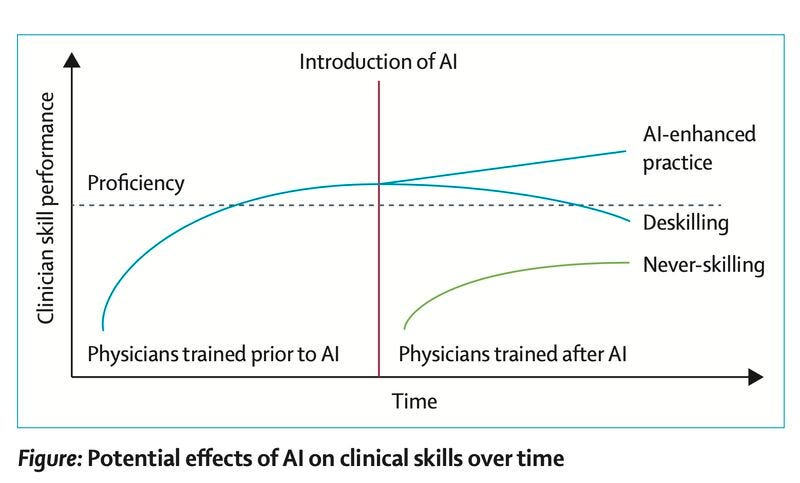
(from Berzin TM, Topol EJ. Preserving clinical skills in the age of AI assistance. Lancet. 2025 Oct 18;406(10513):1719. doi: 10.1016/S0140-6736(25)02075-6. PMID: 41109709.)
In GI - consider a trainee who performs nearly all early colonoscopies with CADe active. For them - a system has always flagged candidate lesions with bounding boxes. Several practical consequences follow.
The trainee experiences far fewer completely unassisted searches on the screen for lesions. Their baseline sense of whether the mucosa has been adequately inspected is shaped by system cues.
They may focus less on developing a personal, systematic search pattern, since the device appears to provide one.
Their internal calibration of what counts as a “good” examination is anchored to the AI-augmented performance world.
We do not yet have definitive empirical data about how trainees who start with AI differ from those trained without it, and designing those studies will be complex. It is reasonable, however, to recognize the risk that certain micro skills will not develop to the same depth if they are rarely required. Berzin and Topol elaborate on this well in their recent piece in The Lancet.
Does it matter if some of these skills never fully develop because of AI?
The answer depends on the task and on how reliably AI and associated infrastructure can be provided.
There are skills that are plausibly fully offloadable. For example, complex dose calculations (such as for chemotherapy) are now routinely handled by electronic prescribing systems. Most educators would not insist that all physicians maintain facility with manual nomograms, provided that systems are robust, audited, and accompanied by safety checks.
Other skills are partially offloadable. Back to GI - in colonoscopy, if CADe consistently improves ADR and reduces miss rates when in use, it may be appropriate to rely on it as part of routine screening practice. At the same time, a minimal level of unaided detection and structured inspection likely remains important for situations where AI is unavailable, technically limited, or where its performance degrades because the case falls outside its training distribution.
Finally, there are skills that are not easily offloadable. These still are difficult to define, but I would be posit skills like the following:
Clinical reasoning and decision making i.e. even if AI suggests options, clinicians still need an internal model of illness and treatment to recognize when those suggestions fit the case and when they do not.
Safety, risk recognition and escalation
Here the focus is on detecting early signs of deterioration, identifying when a plan is unsafe, and knowing when to escalate care or change course. Or even recognising when AI output is implausible, incomplete or inconsistent with the overall clinical picture, then taking appropriate corrective action.Communication and relational work
This covers explaining diagnoses, uncertainty and trade offs in plain language for patients. It will likely extend to discussing the role of AI in care and its limitations, and incorporating patient values into shared decisions. These interactions depend on trust, empathy and context - AI can support them but will never replace the underlying relational skills.Professional responsibility and systems thinking
Clinicians still carry responsibility for final decisions, including documenting their reasoning and being prepared to justify choices to patients, colleagues and regulators. They also need to understand how local systems, resources and policies shape what is possible, and to participate in monitoring and improving AI enabled workflows when problems arise. AI won’t be able to take this over.
Educational responses in a neverskilling environment
If we accept that AI will be present from the start of training for many learners, and if we want to develop skills that may not develop with AI, several design principles follow.
1. Stage exposure to AI
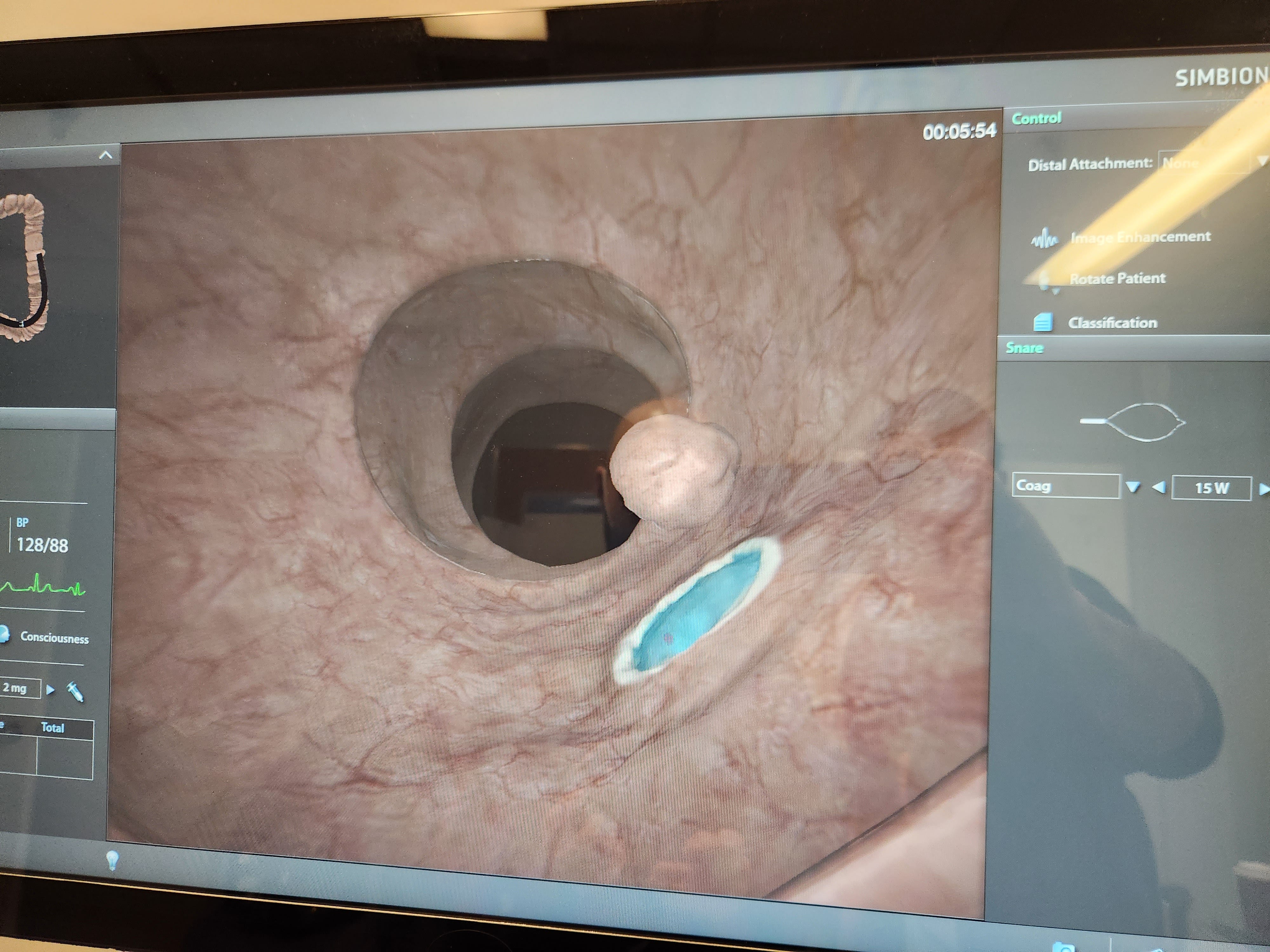
Where feasible, learners should have some early experience with tasks in AI off environments, particularly in simulation or other low risk settings. Simulation based curricula of this type have already been shown to improve early clinical performance.
2. Intentionally mix AI on and AI off conditions
During clinical rotations, incorporating both AI assisted and unassisted sessions can help maintain core skills and give educators a clearer view of what learners can do in each mode. In the easy example of endoscopy, this might mean some lists where CADe is active and others where it is not, with explicit discussion of technique and inspection strategy after each. In clinic, some notes could be drafted entirely by the learner, then compared against AI generated documentation.
This approach also generates data for research on neverskilling. Performance can be tracked longitudinally in both conditions, with attention to safety.
3. Assess the human, not only the human plus AI system
Entrustment decisions and progression milestones should, where possible, include observations of unaided performance, supported performance, and the learner’s ability to supervise AI output. For example, an assessment blueprint might specify that a trainee must demonstrate:
Adequate unaided inspection in a small number of colonoscopies.
Effective use of CADe without over reliance, including appropriate disregard of false positives.
Clear articulation of what the AI is doing during the procedure and how it might fail.
Objective structured assessments or simulation stations can be designed with and without AI to probe these dimensions. Ambient AI-augmented assessment may also assist with this in real-world sessions.
4. Teach AI related “meta skills” explicitly
If AI is part of routine practice, then skills such as model calibration, bias recognition, data stewardship, and consent for AI use should be treated as explicit learning outcomes rather than implicit side effects. Learners should have language and tools to say, in effect, “This AI suggestion is plausible but incorrect, and here is why”.
Conclusion
Neverskilling will not be addressed by simple rules about when learners may or may not use AI. It forces us to decide which skills can be safely offloaded, which must be retained at a baseline level, and what new oversight and reasoning abilities we expect from clinicians who work with AI from the start of training.
Answering those questions will require more empirical work that links different training approaches to patient outcomes, as well as careful qualitative study of how learners, supervisors and patients experience AI saturated environments. This will be a very interesting line of inquiry into human-AI interaction (HAII). In parallel, programs and regulators will need open, explicit discussion about expectations for future clinicians, rather than leaving these decisions to drift as technology rapidly advances past the time when those decisions should have been made.
Thanks for this thoughtful read - the calculator analogy resonates... appreciating that there are ++orders of magnitude btw calculators and AI!
Couldn't agree more. This definetly changes how we view learning. What new skills will emerge?